How To Conduct Competitor Keyword Gap Analysis To Find Unexploited Low Difficulty Search Terms Quickly
When launching or scaling a digital platform like bestpetstuff.com across competitive regional markets—such as Texas, New York, California, Washington, and San Francisco—relying on guesswork or generic seed keyword lists will trap your domain in the search engine sandbox. Established authority sites already dominate broad, high-volume terms. Trying to outrank them head-on without an established backlink profile is an inefficient use of resources.
The fastest, most data-driven shortcut to earning organic visibility is a Competitor Keyword Gap Analysis. By systematically evaluating what search terms your top-performing competitors rank for—and where your domain has zero presence—you can uncover hidden, low-difficulty search terms that yield immediate traffic and conversions.
This exhaustive, highly informative masterclass explores the mechanics of keyword gap analysis, outlines advanced filtering frameworks, and provides a step-by-step blueprint to find and capture unexploited search terms quickly.
1. The Core Mechanics of a Keyword Gap Analysis
To understand why gap analysis outperforms standard brainstorming, you must look at how search algorithms and competitor ecosystems interact:
[Competitor Domain A] \
                       ---> [Overlapping & Missing Keyword Matrix] ---> [Unexploited Low-Difficulty Gaps] ---> [Targeted Content Assets]
[Competitor Domain B] /
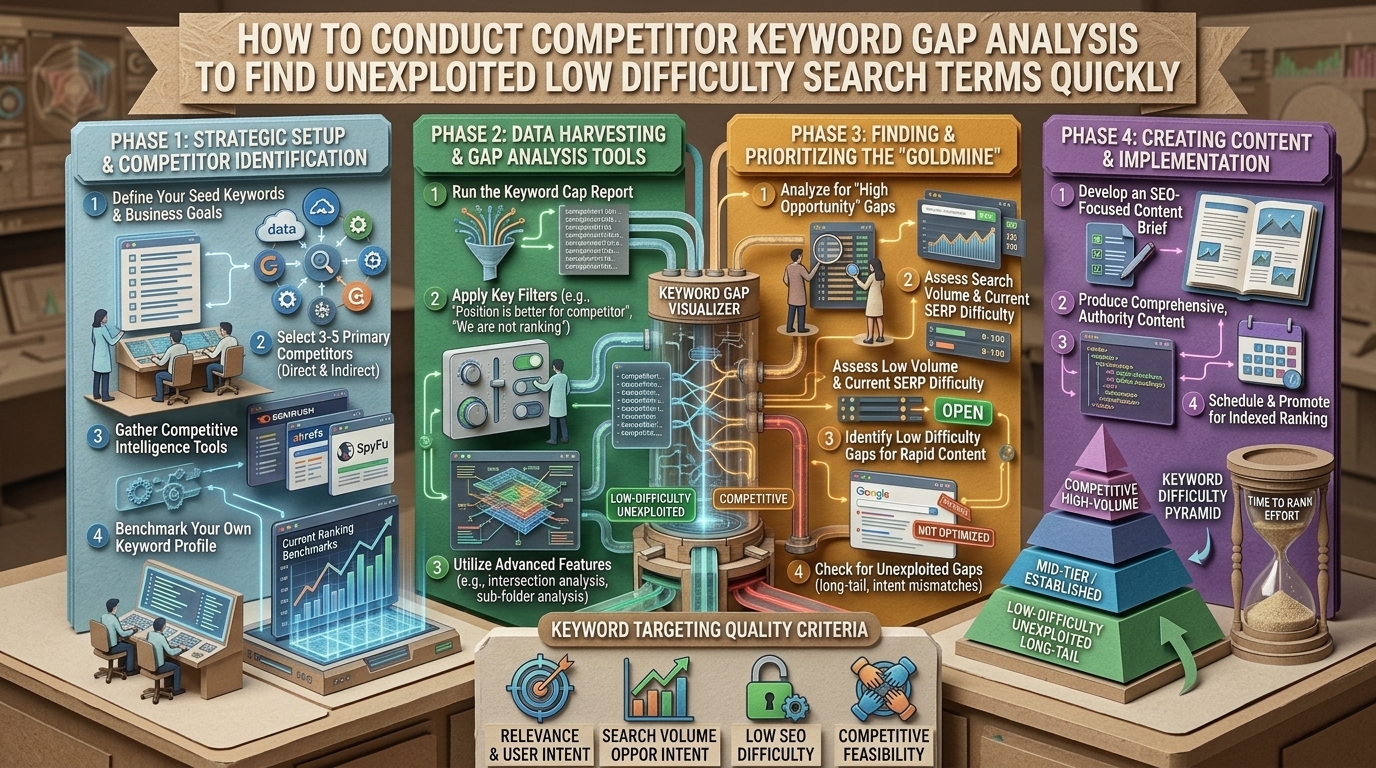
- What is a Keyword Gap? A keyword gap analysis compares your website’s organic keyword portfolio against 3 to 5 direct search competitors to isolate terms where they rank on page one, but your domain is completely missing or underperforming.
- The Low-Difficulty Multiplier: Many established competitors rank for hundreds of long-tail, hyper-specific queries by accident due to their sheer domain authority, without having optimized specifically for them. This creates massive opportunities for a newer niche site to target those exact low-difficulty terms with superior, intent-matched content and outrank them.
2. Phase 1: Identifying True SEO Competitors (Not Just Business Rivals)
Your business competitors are not always your search engine competitors. A massive national retail brand might sell similar products, but your true SEO rivals are the niche publishers, regional blogs, or aggregators currently occupying the top five spots for your core topic clusters.
Step 1: Map Your Core Seed Categories
- Action: Define your primary content pillars (e.g., pet nutrition, regional pet travel laws, specialized grooming accessories).
- Execution: Plug these core pillars into an SEO tool (such as Semrush, Ahrefs, or SE Ranking) to generate a baseline list of ranking domains.
Step 2: Select 3 to 5 Laser-Focused Competitors
- Action: Narrow your list down to 3 to 5 domains that consistently appear across your target SERPs. Avoid massive generalist hubs (like Amazon or Wikipedia) if possible, and focus on mid-tier authority sites whose content structure you can realistically emulate and surpass.
3. Phase 2: Executing the Keyword Gap Workflow
Once your competitor URLs are locked into your SEO software’s Keyword Gap tool, execute the following configuration steps:
[Raw Competitor Export]
       ↓
[Filter 1: Keyword Difficulty (KD ≤ 25)]
       ↓
[Filter 2: Minimum Search Volume (MSV ≥ 50)]
       ↓
[Filter 3: Intent Clustering (Informational vs. Transactional)]
       ↓
[Actionable Content Execution Roadmap]
1. Configure the Comparison Matrix
- Action: Input your domain as the primary baseline, and add your 3 chosen competitors into the comparison fields. Set the filter view to show keywords where “Competitors rank, but my domain does not.”
2. Apply Strict Low-Difficulty Filters (KD)
- Action: Filter the raw output to isolate terms with a Keyword Difficulty (KD) score of 25 or below (depending on the tool’s scale). For a newer domain, these are your fastest paths to first-page rankings.
3. Filter for Minimum Search Volume (MSV) Thresholds
- Action: Do not ignore low-volume terms. Search terms with 50 to 300 monthly searches often feature zero competition, incredibly high conversion intent, and aggregate into thousands of monthly visits when scaled across clusters.
4. Phase 3: Segmenting by Search Intent and Funnel Stage
Unfiltered keyword lists are useless unless classified by intent. Group your extracted keyword gaps into specific user funnels:
- Informational Gaps: Questions and long-tail guides (e.g., “Are raw carrots safe for senior dogs with sensitive digestion?”). Ideal for blog posts, FAQ expansions, and capturing AI search citations.
- Commercial Investigation Gaps: Comparison and evaluation queries (e.g., “Best stainless steel dog crates for heavy chewers in hot climates”). Ideal for roundup reviews and product category guides.
- Transactional Gaps: High-intent buying queries (e.g., “Organic calming treats for cats with shipping to San Francisco”). Ideal for product landing pages and localized service hubs.
5. Best Practices for Rapid Content Deployment
- Avoid Cannibalization: Before writing new articles for every single gap, check whether an existing page on your site can be expanded to cover the new keyword cluster.
- Out-Execute Competitors on Depth and Design: When you find a gap where a competitor ranks with a thin, outdated 400-word post, build an exhaustive 2,500-word masterclass complete with original data, comparison tables, and FAQ schemas.
- Track Velocity via Google Search Console: Monitor how quickly Google indexes your newly targeted gap pages and track impressions growth week-over-week.
6. Frequently Asked Questions (FAQ)
1. What is a competitor keyword gap analysis?
A competitor keyword gap analysis is an SEO workflow that compares your website’s ranking profile against your top competitors to identify high-value search terms they rank for that you do not.
2. Why is keyword gap analysis better than manual brainstorming?
Gap analysis is rooted in verified market data, showing you exact search terms that competitors are already successfully using to attract traffic and conversions.
3. How many competitors should you analyze at once?
Analyzing 3 to 5 close competitors is the sweet spot; reviewing more dilutes your data and makes prioritization overly complex.
4. What is considered a “low difficulty” keyword score?
While metrics vary by tool, a Keyword Difficulty (KD) score under 25 or 30 is generally considered low difficulty and achievable for newer domains.
5. Should a new domain target low-volume search terms?
Yes. Low-volume search terms (50–300 monthly searches) often feature very low competition and high conversion intent, serving as the foundation for early organic traction.
6. How do you handle keyword gaps that overlap with multiple competitors?
Prioritize keyword gaps where two or more of your competitors rank simultaneously, as this signals strong search engine validation for that topic cluster.
7. What is the difference between informational and transactional keyword gaps?
Informational gaps answer “how” or “what” questions (ideal for blog posts), while transactional gaps target immediate purchase intent (ideal for product/category pages).
8. How often should a website run a keyword gap analysis?
You should run a comprehensive gap analysis bi-annually, complemented by a lightweight quarterly refresh to capture emerging search trends.
9. Can keyword gap analysis help optimize content for AI search engines?
Yes. Uncovering long-tail question gaps allows you to structure direct answer blocks and FAQ schemas that AI search engines pull into conversational summaries.
10. Where should an enterprise begin its first keyword gap project?
An enterprise should start by defining 3 core business pillars, identifying 3 true SEO rivals in those spaces, and running a filtered export for low-difficulty, high-intent query gaps.
7. Conclusion
Conducting a competitor keyword gap analysis removes the guesswork from organic growth. By systematically mining the blind spots of your top competitors, filtering for low-difficulty long-tail queries, and structuring your content around precise user intent, your brand-new domain can bypass months of trial and error. Execute this step-by-step framework today to uncover unexploited search terms, capture high-intent traffic, and accelerate your path to top-tier organic authority.